The short answer: the biggest World Cup ever
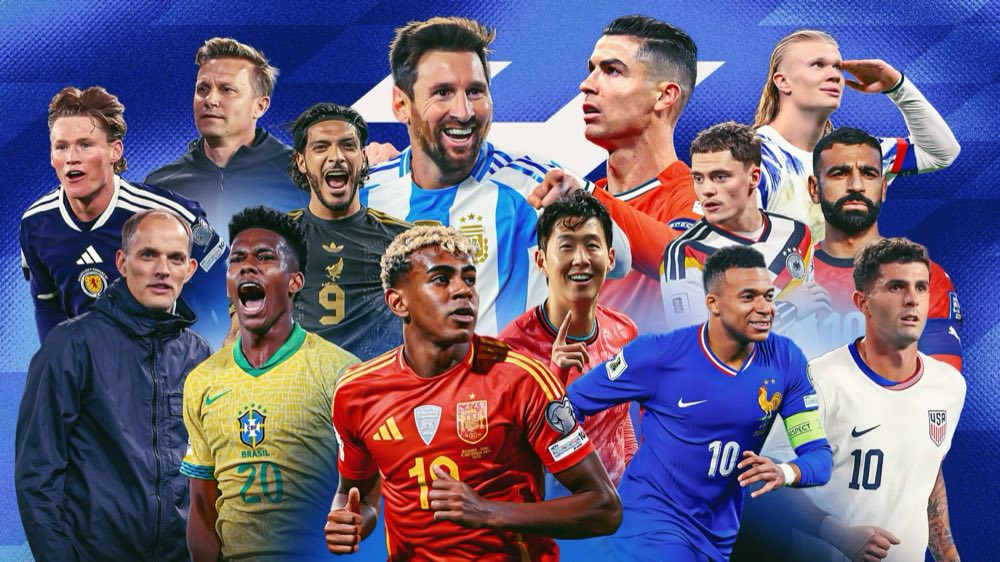
Why is the 2026 World Cup historic? Because it is the first to feature 48 teams (up from 32), the first hosted by three nations — the United States, Mexico and Canada — and the first to play 104 matches across 16 cities. It is the largest, most-attended and most-watched World Cup ever staged, and it permanently changes the tournament's format.
At IPTV4WorldCup we have tracked every World Cup broadcast detail for this tournament, and one thing is clear: 2026 is not just another edition. Running from June 11 to July 19, 2026, the FIFA World Cup 2026 breaks more records before a ball is kicked than most tournaments break in total. It is bigger, longer, more global and more commercially ambitious than anything in the competition's 96-year history. Below are the eleven concrete reasons it is already being written into the history books.
1. Forty-eight teams — the largest field in history
The single biggest reason 2026 is historic: the World Cup has expanded from 32 teams to 48 — the first increase since the 1998 tournament grew the field from 24 to 32. It is the largest expansion in the competition's history and brings the finals to nearly a quarter of FIFA's 211 member associations.
More places mean more nations get their shot. Several countries will appear at a men's World Cup for the very first time, and confederations that historically squeezed a handful of teams through qualifying now send many more:
| Confederation | Region | Direct 2026 slots (approx.) |
|---|---|---|
| UEFA | Europe | 16 |
| CAF | Africa | 9 |
| AFC | Asia | 8 |
| CONMEBOL | South America | 6 |
| CONCACAF | N./C. America (incl. 3 hosts) | 6 |
| OFC | Oceania | 1 (first-ever direct slot) |
| Play-off | Inter-confederation | 2 (via 6-team play-off) |
Oceania receiving a guaranteed direct place for the first time is historic on its own. The expansion is the headline change that every other record flows from.
2. A record 104 matches across 16 host cities
More teams means dramatically more football. The 2026 World Cup will be decided over 104 matches — up from 64 in every tournament since 1998. That is a 63% increase in matches, turning a roughly month-long event into a 39-day festival from June 11 to July 19.
Those matches are spread across 16 host cities in three countries — the most venues a World Cup has ever used:
- United States (11 cities): New York/New Jersey, Los Angeles, Dallas, San Francisco Bay Area, Miami, Atlanta, Seattle, Houston, Philadelphia, Kansas City and Boston.
- Mexico (3 cities): Mexico City, Guadalajara and Monterrey.
- Canada (2 cities): Toronto and Vancouver.
For fans this is a genuinely new experience: a tournament so large that, for the first time, no single broadcaster in any country comfortably carries every match on free TV — one reason streaming and IPTV have become central to following it. See our complete World Cup 2026 guide to all 16 stadiums and 104 matches for the full map.
3. The first World Cup co-hosted by three nations
Every previous World Cup was awarded to one country, with only two exceptions: 2002, co-hosted by South Korea and Japan. 2026 is the first tournament hosted by three nations at once — the United States, Mexico and Canada — under the joint bid originally branded "United 2026."
That is historic for several reasons:
- Scale of logistics. Teams, fans, officials and broadcasters move across three countries, multiple time zones and two international borders — an operational challenge no prior World Cup has faced.
- It is Canada's first men's World Cup. Canada has never hosted men's World Cup matches before; in 2026 it stages games in Toronto and Vancouver.
- A continental tournament. Spanning the breadth of North America, 2026 is effectively a continent-wide event rather than a single-nation one.
4. Mexico and the Estadio Azteca rewrite the record books
One of the most beautiful historic notes of 2026 belongs to Mexico. With this tournament, Mexico becomes the first country to host (or co-host) the men's World Cup three times — after 1970 and 1986.
Even more remarkable: the Estadio Azteca in Mexico City becomes the first stadium in the world to host matches at three different men's World Cups. The same ground that staged Pelé's 1970 triumph and Diego Maradona's 1986 "Hand of God" and "Goal of the Century" returns in 2026 — and is set to host the opening match on June 11, 2026. No other venue in football history carries that distinction.
5. A brand-new tournament format
Expanding to 48 teams forced FIFA to redesign the competition itself — so 2026 introduces a format never used at a World Cup before.
The group stage now features 12 groups of 4 teams (instead of 8 groups of 4). The top two from each group, plus the eight best third-placed teams, advance — sending 32 teams into the knockouts. That creates an entirely new round:
| Stage | 1998–2022 (32 teams) | 2026 (48 teams) |
|---|---|---|
| Groups | 8 groups of 4 | 12 groups of 4 |
| First knockout | Round of 16 | Round of 32 (new) |
| Total matches | 64 | 104 |
| Matches for the winner | 7 | 8 |
For the first time, the eventual champions will need to win or survive eight matches rather than seven — a longer, more demanding road to the trophy that rewards squad depth. Wondering who that road favors? Read our breakdown of who will win the 2026 World Cup.
6–9. The records set to fall
Beyond the structural firsts, 2026 is on course to break a cluster of all-time records:
- 6. Most-attended World Cup ever. With 104 matches in some of the largest stadiums in North America — several holding 70,000+ — total attendance is projected to comfortably surpass the previous record set at USA 1994, which still holds the per-match average record.
- 7. Biggest commercial World Cup. FIFA has openly targeted record revenue from the expanded tournament, driven by more matches, more sponsors and more broadcast inventory than ever before.
- 8. Widest broadcast reach. More teams means more nations with a direct rooting interest, pushing the global television and streaming audience to new highs across more markets and languages.
- 9. Most debutants in decades. The jump to 48 places opens the door for multiple nations to reach a first-ever World Cup, the broadest wave of newcomers the tournament has seen in a generation.
10–11. Legacy, and the future it unlocks
10. A template for the future. 2026 is the first edition of a permanently larger World Cup. The 48-team format is now the standard going forward, meaning every tournament after this one inherits the blueprint built in North America — making 2026 the pivot point between the old World Cup and the new era.
11. The gateway to a new hosting era. 2026 also sets up an unprecedented run of tournaments. FIFA has confirmed that 2030 will be a centenary edition spread across six countries on three continents — with hosting led by Morocco, Spain and Portugal and celebratory opening matches in Uruguay, Argentina and Paraguay (where the first World Cup was held in 1930) — and that 2034 will be hosted by Saudi Arabia. 2026 is the tournament that opens this bold, globe-spanning chapter.
Put together, these eleven firsts are why historians, broadcasters and FIFA itself describe 2026 as a watershed: the moment the World Cup became a truly continental, 48-nation spectacle.
How to watch this historic World Cup
A 104-match tournament across three countries and four time zones is genuinely hard to follow on any single channel — which is exactly why how you watch matters more in 2026 than ever before.
- Free, in the right country: the UK gets all 104 matches free across BBC and ITV; the US has every match free in Spanish on Telemundo; ARD/ZDF, TVE, SVT and NOS carry the big games elsewhere. Full breakdown in how to watch World Cup 2026 for free.
- Every match, every team, one feed: IPTV4WorldCup aggregates all the World Cup broadcasters — BBC, ITV, FOX, Telemundo, ARD, ZDF, TF1, beIN and 40,000+ channels — into one subscription at $7.50/month on the annual plan, in 4K with multi-language commentary and no geo-blocks.
Start with the live match hub for today's fixtures, see who lifts the trophy in our 2026 contenders analysis, or read the full World Cup 2026 streaming guide for venues, schedule and channels.
Frequently asked questions
Why is the 2026 World Cup considered historic?
The 2026 World Cup is historic because it is the first with 48 teams (up from 32), the first hosted by three nations (USA, Mexico and Canada), and the first played over 104 matches across 16 cities. It is the largest, longest and most-attended World Cup ever, and it permanently changes the tournament's format.
How many teams are in the 2026 World Cup?
48 teams — up from 32 at every tournament between 1998 and 2022. It is the largest field in World Cup history and the first expansion since 1998, bringing the finals to nearly a quarter of FIFA's member nations.
How many matches are played at the 2026 World Cup?
104 matches, up from 64. That is a 63% increase, stretching the tournament to 39 days, from June 11 to July 19, 2026, across 16 host cities in the United States, Mexico and Canada.
Which countries are hosting the 2026 World Cup?
Three countries co-host for the first time: the United States (11 cities), Mexico (3 cities) and Canada (2 cities). It is Canada's first time hosting men's World Cup matches and only the second co-hosted World Cup after South Korea/Japan 2002.
Why is Mexico's hosting historic?
Mexico becomes the first country to host the men's World Cup three times (1970, 1986, 2026), and Mexico City's Estadio Azteca becomes the first stadium ever to host matches at three different men's World Cups. The Azteca is set to stage the opening match on June 11, 2026.
What is the new 2026 World Cup format?
The group stage has 12 groups of 4 teams. The top two from each group plus the eight best third-placed teams advance, creating a new Round of 32 before the Round of 16. The champions must now win eight matches instead of seven.
Where are the opening match and final of the 2026 World Cup?
The tournament opens at the Estadio Azteca in Mexico City on June 11, 2026, and the final is at MetLife Stadium in New York/New Jersey on July 19, 2026.
Will the 2026 World Cup be the biggest ever?
Yes. With 48 teams, 104 matches and 16 venues it is already the largest World Cup by every structural measure, and it is projected to be the most-attended and most-watched in history. It also sets the permanent 48-team template for all future tournaments.